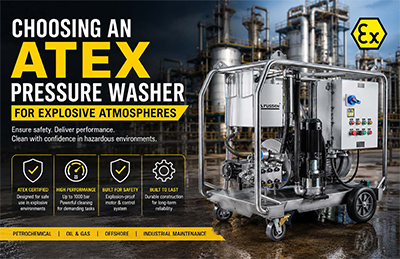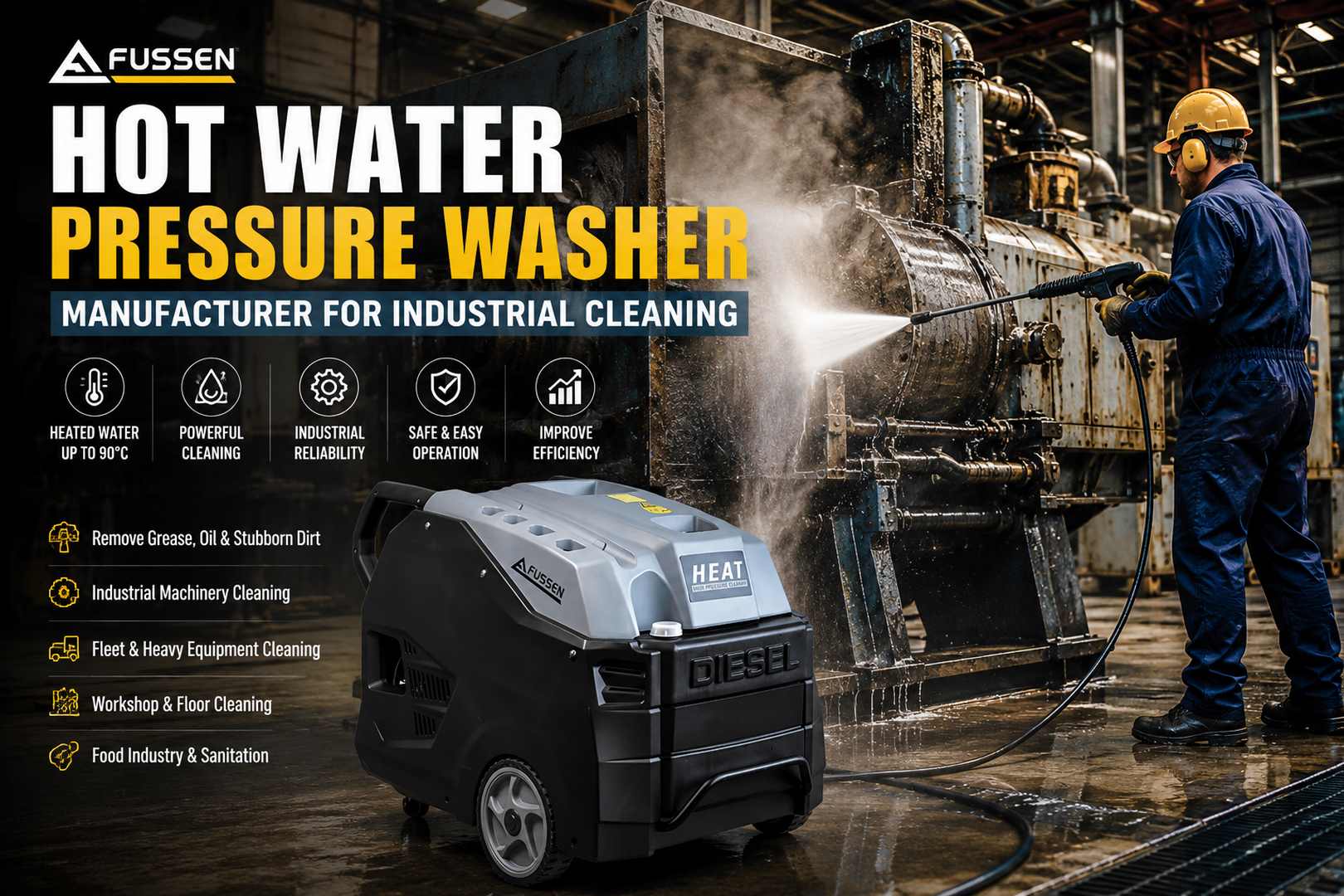
En entornos industriales peligrosos, la seguridad es tan importante como la eficacia de la limpieza. Las hidrolimpiadoras convencionales pueden generar chispas, calor o arcos eléctricos a partir de motores, interruptores y componentes de control, creando posibles fuentes de ignición en zonas donde hay gases inflamables, vapores o polvo combustible.
Una hidrolimpiadora antiexplosiva está diseñada específicamente para operar de forma segura en entornos de alto riesgo. Equipadas con motores antiexplosivos, sistemas eléctricos protegidos y componentes que cumplen con las normas ATEX o IECEx, estas máquinas ayudan a reducir los riesgos de explosión a la vez que ofrecen un potente rendimiento de limpieza.
Industrias como la del petróleo y el gas, la petroquímica, el procesamiento químico, las plataformas marinas, las instalaciones de almacenamiento de combustible y las refinerías suelen requerir equipos de limpieza a prueba de explosiones para cumplir con las normas de seguridad y proteger al personal, los activos y las operaciones. En esta guía, exploraremos cómo funcionan las hidrolimpiadoras a prueba de explosiones, dónde se utilizan y cómo elegir la hidrolimpiadora adecuada para áreas peligrosas según sus necesidades.
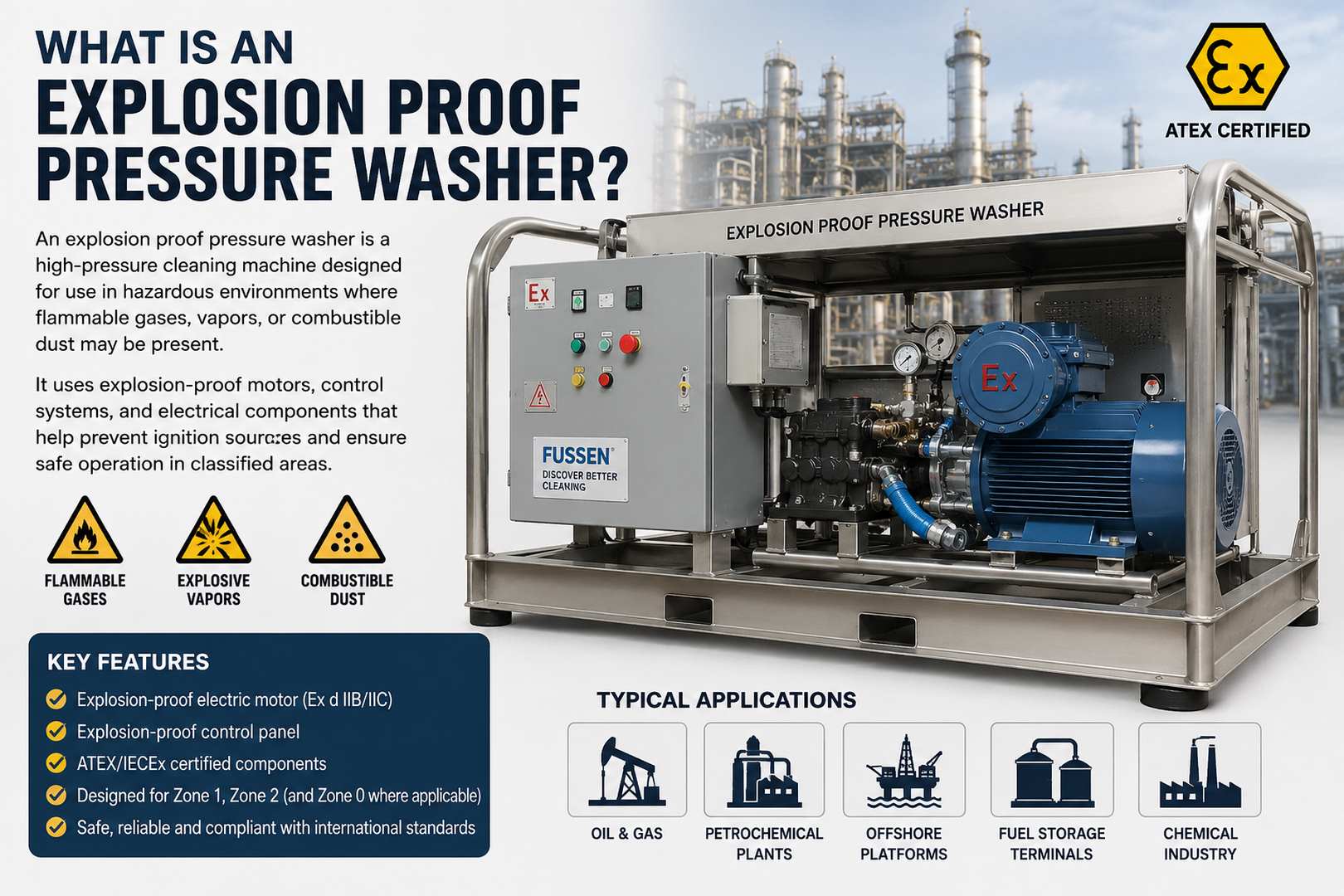
Un hidrolimpiadora a prueba de explosiones Es una máquina de limpieza de alta presión especializada, diseñada para su uso en entornos peligrosos donde pueden estar presentes gases, vapores, líquidos o polvo combustible inflamables. A diferencia de las hidrolimpiadoras estándar, incorpora motores antideflagrantes, componentes eléctricos con clasificación Ex y sistemas de control protegidos que evitan que chispas, arcos eléctricos o calor excesivo provoquen la ignición de atmósferas explosivas.
Estas máquinas se utilizan ampliamente en refinerías de petróleo, plantas petroquímicas, plataformas marinas, instalaciones de procesamiento químico, terminales de almacenamiento de combustible y otros lugares peligrosos donde la seguridad industrial y el cumplimiento de la normativa son fundamentales.
El principio de funcionamiento de una hidrolimpiadora antiexplosiva es similar al de un sistema de limpieza de alta presión convencional. El agua se presuriza mediante una bomba de émbolo de alta presión y se descarga a través de una boquilla especializada para eliminar suciedad, grasa, residuos de aceite, óxido, pintura y otros contaminantes.
La principal diferencia radica en el diseño eléctrico y mecánico de la máquina. Componentes críticos como el motor, el panel de control, los interruptores y el cableado están diseñados para contener o prevenir fuentes de ignición. Esto permite que el equipo funcione de forma segura en áreas peligrosas, manteniendo al mismo tiempo un potente rendimiento de limpieza.
Existen numerosos limpiadores industriales a prueba de explosiones con certificación ATEX, conformidad con la norma IECEx u otras certificaciones para áreas peligrosas, que permiten cumplir con los requisitos de seguridad específicos de cada instalación.
Aunque ambos tipos de equipos realizan limpieza a alta presión, las hidrolavadoras a prueba de explosiones están diseñadas específicamente para limpieza de zonas peligrosas y el cumplimiento normativo.
| Hidrolavadora estándar | Hidrolavadora a prueba de explosiones |
|---|---|
| Motor estándar | Motor a prueba de explosiones |
| Caja de control estándar | Caja de control con clasificación Ex |
| Uso industrial general | Uso en zonas peligrosas |
| Requisitos de cumplimiento más bajos | Cumplimiento con ATEX/IECEx |
| Las posibles fuentes de ignición pueden estar expuestas. | Diseñado para prevenir o contener fuentes de ignición |
| Adecuado para entornos operativos normales. | Adecuado para atmósferas explosivas y lugares peligrosos. |
| Requisitos de seguridad limitados | Cumple con los estrictos estándares de seguridad industrial. |
Para instalaciones que operan en zonas ATEX 1 y 2, áreas de procesamiento químico o entornos de petróleo y gas, el uso de una hidrolavadora estándar puede generar riesgos de seguridad significativos. Una hidrolavadora ATEX ofrece la protección, confiabilidad y cumplimiento normativo necesarios para operar de forma segura en estas exigentes condiciones.
La elección de la hidrolimpiadora antiexplosiva adecuada comienza por comprender las clasificaciones de áreas peligrosas y los requisitos de certificación. Normas como ATEX e IECEx ayudan a determinar si el equipo puede utilizarse de forma segura en entornos donde puedan estar presentes gases inflamables, vapores o polvo combustible. Comprender estas clasificaciones garantiza el cumplimiento, reduce los riesgos de seguridad y ayuda a los compradores a seleccionar la hidrolimpiadora adecuada para sus instalaciones.
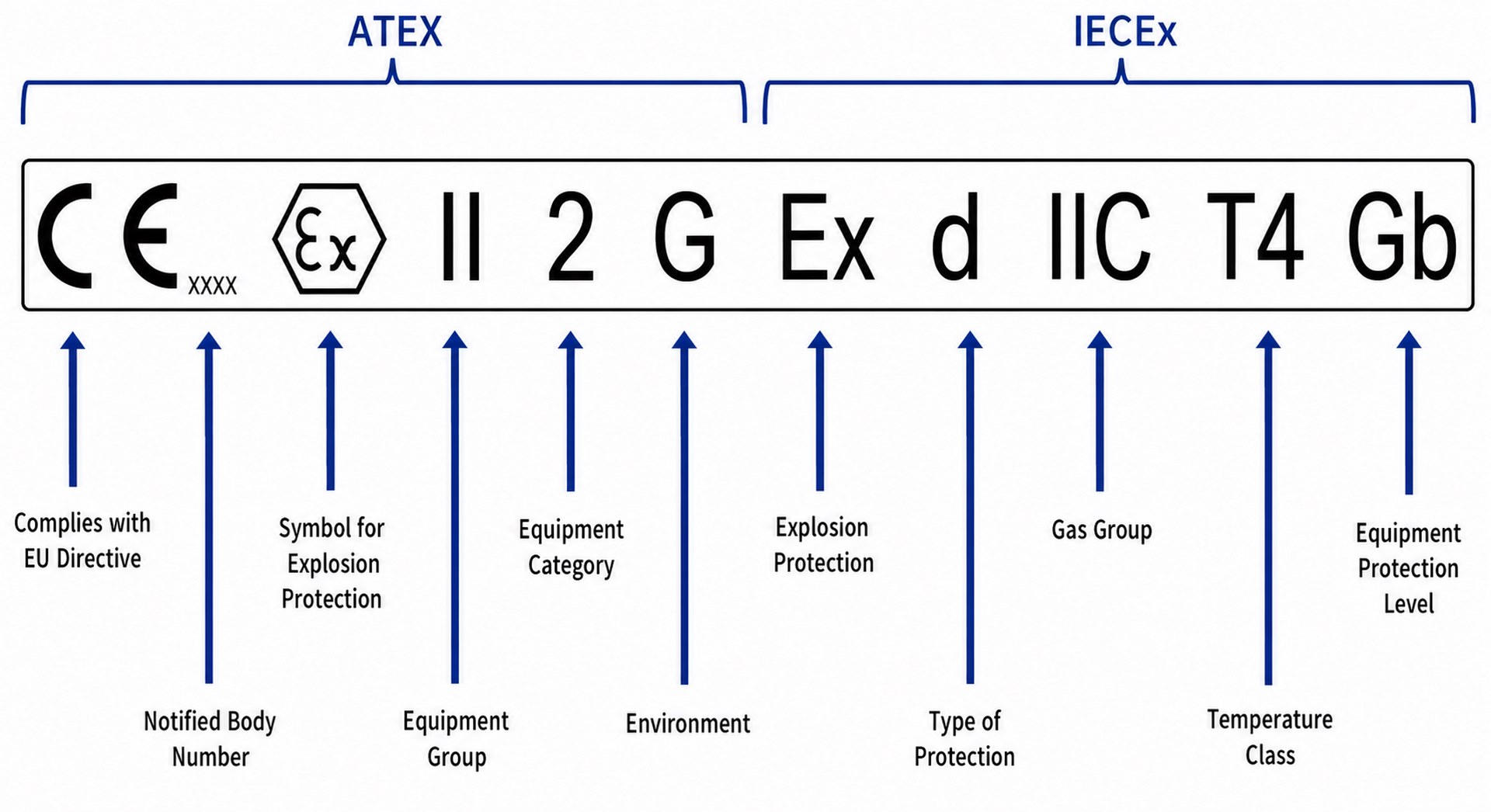
ATEX es un marco regulatorio europeo que rige los equipos destinados a ser utilizados en atmósferas potencialmente explosivas. El término "ATEX" tiene su origen en la frase francesa. Atmósferas Explosivas.
Las hidrolimpiadoras con certificación ATEX están diseñadas y probadas para prevenir la ignición en entornos peligrosos. Los equipos con certificación ATEX se utilizan habitualmente en refinerías de petróleo, plantas petroquímicas, plataformas marinas, depósitos de combustible y plantas de procesamiento químico en toda Europa y en muchos mercados internacionales.
Para las instalaciones que operan en regiones reguladas por la normativa ATEX, seleccionar una hidrolimpiadora ATEX suele ser un requisito de seguridad obligatorio.
IECEx es un sistema de certificación internacional desarrollado por la Comisión Electrotécnica Internacional (IEC). Si bien ATEX se aplica principalmente al mercado europeo, IECEx proporciona estándares reconocidos a nivel mundial para equipos utilizados en atmósferas explosivas.
Muchas empresas multinacionales prefieren equipos con certificación IECEx porque simplifica el cumplimiento normativo en múltiples países e instalaciones industriales. Una hidrolavadora antiexplosiva con certificación IECEx demuestra que el equipo ha sido sometido a pruebas rigurosas y cumple con los estándares de seguridad internacionalmente aceptados.
Las zonas peligrosas se clasifican según la probabilidad y la duración de la presencia de atmósferas explosivas.
| Zona | Descripción | Nivel de riesgo |
|---|---|---|
| Zona 0 | La atmósfera explosiva está presente de forma continua o durante largos periodos. | Muy alto |
| Zona 1 | Es probable que se produzca una atmósfera explosiva durante las operaciones normales. | Alto |
| Zona 2 | Es improbable que se produzca una atmósfera explosiva durante las operaciones normales, pero puede ocurrir ocasionalmente. | Moderado |
Por ejemplo, el interior de un tanque de almacenamiento de combustible puede clasificarse como Zona 0, mientras que los equipos de procesamiento circundantes pueden clasificarse como Zona 1 o Zona 2.
Comprender estas zonas es fundamental a la hora de seleccionar equipos de limpieza a prueba de explosiones, ya que los diferentes entornos requieren diferentes niveles de protección.
Los equipos a prueba de explosiones se clasifican además según el tipo de gases con los que pueden funcionar de forma segura.
| Clasificación | Grupos de gases adecuados | Aplicaciones típicas |
|---|---|---|
| Exd IIB | Etileno y gases similares | Plantas petroquímicas, terminales de combustible |
| Exd IIC | Hidrógeno, acetileno y todos los gases IIB | Refinerías, plantas químicas, instalaciones de hidrógeno |
Los equipos Exd IIC ofrecen un mayor nivel de protección y, por lo general, pueden utilizarse en entornos donde se permite el uso de equipos Exd IIB. Muchos compradores industriales eligen hidrolimpiadoras antiexplosivas con clasificación Exd IIC cuando se requiere la máxima seguridad y flexibilidad.
La certificación adecuada depende de su ubicación, sector industrial y clasificación de la zona peligrosa. En Europa, las instalaciones suelen requerir hidrolimpiadoras con certificación ATEX, mientras que en proyectos internacionales puede especificarse la certificación IECEx. También deben tenerse en cuenta el grupo de gases, la clase de temperatura y la clasificación de zona requeridos.
Antes de comprar una hidrolavadora a prueba de explosiones, los operadores de las instalaciones deben evaluar lo siguiente:
Consultar con proveedores de equipos e ingenieros de seguridad puede ayudar a garantizar que el equipo de limpieza a prueba de explosiones seleccionado cumpla con los requisitos operativos y normativos, a la vez que proporciona una fiabilidad a largo plazo en entornos peligrosos.
En industrias donde hay gases, vapores, líquidos o polvo combustible inflamables, el uso de equipos de limpieza estándar puede generar graves riesgos para la seguridad. Una hidrolavadora antiexplosiva está diseñada específicamente para minimizar estos riesgos, garantizando al mismo tiempo el cumplimiento de las normativas industriales y los requisitos de seguridad operativa.
Uno de los objetivos principales de una hidrolavadora a prueba de explosiones es eliminar posibles fuentes de ignición. Los motores, interruptores, conexiones eléctricas y cajas de control estándar pueden generar chispas, arcos eléctricos o calor excesivo durante su funcionamiento. En entornos peligrosos, estas fuentes de ignición pueden ser suficientes para provocar un incendio o una explosión.
Los motores a prueba de explosiones, los paneles de control con clasificación Ex y los componentes eléctricos protegidos ayudan a contener o prevenir la ignición, lo que hace que el equipo sea adecuado para aplicaciones de limpieza en áreas peligrosas.
Instalaciones como refinerías de petróleo, plantas petroquímicas, plataformas marinas e instalaciones de procesamiento químico suelen contener atmósferas explosivas. El uso de una hidrolimpiadora ATEX reduce significativamente el riesgo de ignición accidental durante las operaciones de limpieza y mantenimiento.
Mediante el uso de equipos de limpieza a prueba de explosiones certificados, los operarios pueden realizar de forma segura tareas como la limpieza de tanques de almacenamiento, el mantenimiento de equipos, el desengrase industrial y la limpieza de tuberías sin comprometer la seguridad en el lugar de trabajo.
Muchos emplazamientos industriales deben cumplir con estrictas normas de seguridad y clasificaciones de zonas peligrosas. Normativas como ATEX e IECEx establecen requisitos para los equipos utilizados en atmósferas explosivas a fin de garantizar un funcionamiento seguro.
Una hidrolimpiadora con certificación ATEX ayuda a los operadores de las instalaciones a cumplir con los requisitos reglamentarios, superar las auditorías de seguridad y mantener el cumplimiento de los estándares de la industria, al tiempo que reduce los posibles riesgos legales y operativos.
Las consecuencias de una explosión pueden incluir lesiones graves, interrupción de la producción, daños ambientales y costosas pérdidas de equipos. Invertir en una hidrolavadora para áreas peligrosas ayuda a proteger a los empleados, la infraestructura crítica y las operaciones comerciales.
Al combinar un rendimiento de limpieza a alta presión con funciones de seguridad avanzadas, las hidrolimpiadoras antiexplosivas proporcionan una solución fiable para mantener la limpieza de los equipos, al tiempo que garantizan la seguridad operativa a largo plazo y la protección de los activos.
Las hidrolimpiadoras antiexplosivas son esenciales en industrias donde hay presencia de gases, vapores, productos químicos o materiales combustibles. En estos entornos, los equipos de limpieza no solo deben ofrecer un rendimiento eficaz, sino también cumplir con estrictos requisitos de seguridad y normativas. A continuación, se presentan algunas de las industrias más comunes que utilizan hidrolimpiadoras para zonas peligrosas.
Las refinerías de petróleo, las plantas de procesamiento de gas natural, los pozos de perforación y las instalaciones de oleoductos operan en entornos donde la presencia de atmósferas explosivas es una preocupación constante. El mantenimiento rutinario suele implicar la eliminación de residuos de petróleo, lodos, grasa y otros contaminantes de los equipos y la infraestructura.
Una hidrolavadora de petróleo y gas equipada con componentes a prueba de explosiones permite a los operadores realizar tareas de limpieza de forma segura cumpliendo con las regulaciones de áreas peligrosas. Las aplicaciones comunes incluyen la limpieza de tanques de almacenamiento, limpieza del intercambiador de calor, Mantenimiento de refinerías y limpieza de oleoductos mediante equipos especializados de limpieza de refinerías.
Las instalaciones petroquímicas procesan hidrocarburos y compuestos químicos altamente inflamables, por lo que la seguridad en el lugar de trabajo es una prioridad absoluta. Las operaciones de limpieza deben realizarse con equipos diseñados específicamente para entornos explosivos.
Los equipos de limpieza petroquímica a prueba de explosiones se utilizan ampliamente para la limpieza de reactores, el mantenimiento de líneas de producción, el desengrase de equipos y la preparación de superficies. Una hidrolavadora para plantas químicas ayuda a eliminar residuos químicos, aceites y depósitos sin generar riesgos de ignición en el área de trabajo.
Las plataformas petrolíferas y de gas en alta mar se enfrentan a desafíos únicos, entre ellos: entornos marinos hostiles, Exposición al agua salada y condiciones de operación peligrosas. La limpieza regular es esencial para prevenir la corrosión, mantener la eficiencia del equipo y cumplir con las normas de seguridad.
Los equipos de limpieza antiexplosivos para plataformas marinas se utilizan habitualmente para la limpieza de cubiertas, el mantenimiento de maquinaria, la limpieza de tuberías y la eliminación de corrosión. Los componentes de acero inoxidable y los diseños resistentes a la corrosión son especialmente importantes para garantizar la fiabilidad a largo plazo en aplicaciones marinas.
Los depósitos y terminales de almacenamiento de combustible manejan grandes volúmenes de gasolina, diésel, combustible de aviación y otros productos combustibles. Los vapores generados durante las operaciones de almacenamiento y transferencia pueden crear atmósferas potencialmente explosivas.
Las hidrolimpiadoras antiexplosivas proporcionan una solución segura para la limpieza de depósitos de almacenamiento, zonas de carga, bombas, tuberías y sistemas de contención, al tiempo que ayudan a los operarios a cumplir con la normativa de seguridad industrial.
Las plantas de producción química suelen procesar disolventes volátiles, ácidos y compuestos reactivos. Los equipos de limpieza que se utilizan en estas instalaciones deben ser capaces de operar de forma segura en presencia de sustancias peligrosas y atmósferas explosivas.
Las hidrolimpiadoras antiexplosivas se utilizan con frecuencia para el mantenimiento de equipos, la limpieza de derrames, la eliminación de residuos y la desinfección de áreas de producción, lo que las convierte en una parte importante de los programas de seguridad y mantenimiento de las instalaciones.
Los entornos mineros pueden contener polvo combustible, gas metano y otros materiales peligrosos que aumentan el riesgo de explosiones. La maquinaria pesada, los sistemas de procesamiento y la infraestructura de transporte requieren una limpieza periódica para garantizar un funcionamiento eficiente.
Las hidrolimpiadoras para zonas peligrosas ayudan a los operadores mineros a eliminar de forma segura la suciedad, la grasa y los depósitos minerales de la maquinaria y las instalaciones, al tiempo que reducen los posibles riesgos de ignición.
Las plantas de fabricación de pintura, las líneas de recubrimiento y las cabinas de pulverización suelen contener disolventes y vapores inflamables que requieren estrictos controles de seguridad. El uso de equipos de limpieza estándar en estos entornos puede generar riesgos innecesarios.
Las hidrolimpiadoras antiexplosivas se utilizan habitualmente para limpiar cabinas de pintura, residuos de pintura, equipos de recubrimiento, líneas de producción y sistemas de ventilación, manteniendo al mismo tiempo el cumplimiento de las normas de seguridad laboral y los requisitos para zonas peligrosas.
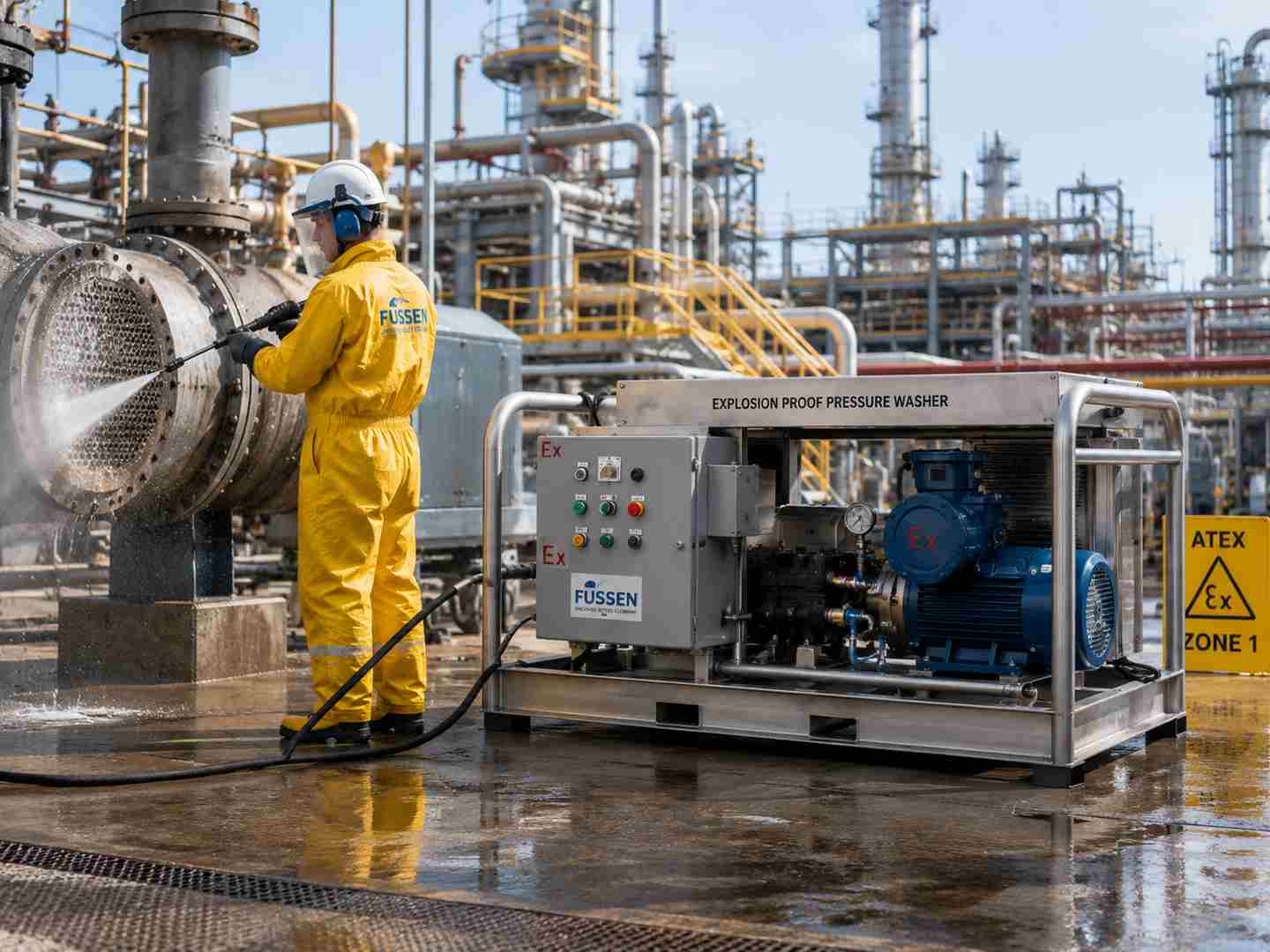
Las hidrolimpiadoras industriales antiexplosivas están diseñadas para ofrecer un potente rendimiento de limpieza, cumpliendo al mismo tiempo con los estrictos requisitos de seguridad de entornos peligrosos. Desde sistemas eléctricos antiexplosivos hasta una construcción robusta, cada componente desempeña un papel fundamental para garantizar un funcionamiento seguro y fiable en industrias como la del petróleo y el gas, la petroquímica, las plataformas marinas y las plantas de procesamiento químico.
El motor es uno de los componentes de seguridad más importantes en una hidrolavadora antiexplosiva. A diferencia de los motores estándar, los motores antiexplosivos están diseñados para contener cualquier chispa, arco eléctrico o calor interno que pudiera encender gases o vapores inflamables.
Estos motores están diseñados específicamente para aplicaciones en áreas peligrosas y contribuyen a garantizar un funcionamiento seguro en entornos ATEX Zona 1 y Zona 2. Según los requisitos de la instalación, el equipo puede estar disponible con clasificaciones Exd IIB o Exd IIC para diferentes grupos de gases.
Los sistemas de control utilizados en zonas peligrosas deben estar protegidos contra posibles fuentes de ignición. Un panel de control antiexplosivo cuenta con carcasas, interruptores, cableado y componentes eléctricos especialmente diseñados para evitar que las chispas o el calor excesivo lleguen a la atmósfera circundante.
Esta protección permite a los operarios arrancar, detener y supervisar la máquina de forma segura, al tiempo que cumplen con la normativa sobre zonas peligrosas y las normas de seguridad industrial.
El bomba de émbolo de alta presión Es el componente principal responsable de generar la potencia de limpieza. Las hidrolimpiadoras industriales a prueba de explosiones suelen utilizar bombas de émbolo de alta resistencia equipadas con émbolos de cerámica o acero aleado y sistemas de sellado de primera calidad.
Estas bombas proporcionan una presión de salida fiable para aplicaciones exigentes como la limpieza de refinerías, la limpieza de tanques de almacenamiento, el desengrase industrial y el mantenimiento de tuberías. Además, las bombas de alta calidad reducen los requisitos de mantenimiento y prolongan la vida útil de los equipos.
Muchos entornos industriales y peligrosos exponen los equipos a la humedad, productos químicos, agua salada y sustancias corrosivas. Las bombas, filtros, conexiones, manómetros y depósitos de agua de acero inoxidable contribuyen a mejorar la durabilidad y a reducir el riesgo de fallos por corrosión.
La construcción en acero inoxidable es especialmente valiosa en equipos de limpieza para plataformas marinas, equipos de limpieza petroquímica e instalaciones de procesamiento químico, donde la fiabilidad a largo plazo es esencial.
La corrosión puede reducir significativamente el rendimiento y la vida útil de los equipos. Los limpiadores industriales a prueba de explosiones suelen incorporar materiales resistentes a la corrosión y recubrimientos protectores para soportar condiciones de funcionamiento adversas.
Esta característica es especialmente importante para plataformas marinas, instalaciones marítimas, refinerías y plantas químicas, donde los equipos están expuestos a entornos agresivos a diario.
Las operaciones de limpieza de zonas peligrosas suelen realizarse en entornos industriales exigentes. Un robusto bastidor industrial proporciona la resistencia y durabilidad necesarias para proteger los componentes críticos durante el transporte y el funcionamiento.
Los bastidores de grado industrial están diseñados para soportar vibraciones, impactos y un uso continuo, manteniendo la estabilidad en condiciones de trabajo exigentes.
Para garantizar el cumplimiento de la normativa sobre zonas peligrosas, los componentes clave, como motores, paneles de control, interruptores y sistemas eléctricos, pueden suministrarse con diseños certificados según las normas ATEX o IECEx.
El uso de componentes con certificación ATEX ayuda a los operadores de las instalaciones a cumplir con los requisitos de seguridad, reducir los riesgos operativos y garantizar que la hidrolavadora antiexplosiva sea apta para su uso en atmósferas potencialmente explosivas. Para industrias como la del petróleo y el gas, la petroquímica, el almacenamiento de combustible y la fabricación de productos químicos, los componentes certificados suelen ser un requisito obligatorio, no una opción.
Elegir la hidrolavadora antiexplosiva adecuada requiere más que simplemente seleccionar la de mayor presión. Los compradores industriales deben considerar la clasificación de áreas peligrosas, los requisitos de limpieza, las fuentes de alimentación y las condiciones de operación para garantizar tanto la seguridad como el rendimiento. Evaluar cuidadosamente estos factores le ayudará a seleccionar la hidrolavadora para áreas peligrosas más adecuada para sus instalaciones.
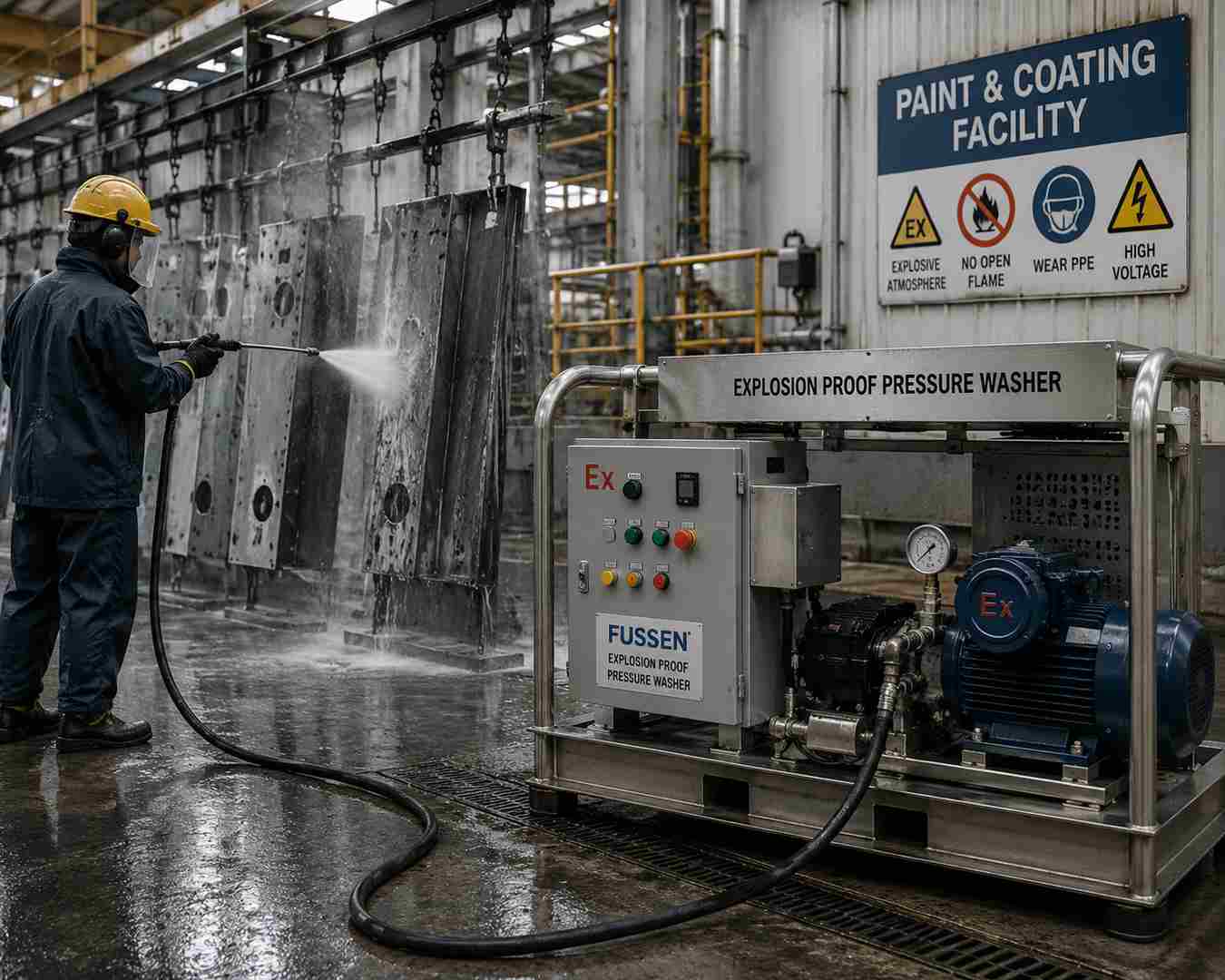
El primer paso es comprender la clasificación de riesgo de explosión de sus instalaciones. Los distintos entornos presentan diferentes niveles de riesgo de explosión, dependiendo de la presencia de gases inflamables, vapores o polvo combustible.
Antes de seleccionar el equipo, determine:
Seleccionar una hidrolimpiadora antiexplosiva con la certificación adecuada garantiza el cumplimiento de la normativa y reduce los riesgos operativos.
Las distintas aplicaciones de limpieza requieren diferentes niveles de presión. Elegir una hidrolimpiadora adecuada para cada tarea mejora la eficiencia y evita costes innecesarios de equipo.
| Solicitud | Rango de presión recomendado |
|---|---|
| Limpieza general de equipos | 150–300 bar |
| Limpieza industrial pesada | 300–500 bar |
| Eliminación de pintura y revestimiento | 500–1000 bar |
| Preparación de la superficie | 500–1400 bar |
| Limpieza con agua a presión y aplicaciones especializadas | Más de 1400 bares |
Una mayor presión no siempre es mejor. La presión ideal depende del tipo de contaminación, el material de la superficie y el objetivo de la limpieza.
El caudal es tan importante como la presión. Mientras que la presión determina la fuerza de limpieza, el caudal de agua determina la velocidad y la productividad de la limpieza.
Generalmente se prefieren caudales más altos para:
Por ejemplo, una hidrolimpiadora de alto caudal para zonas peligrosas puede limpiar equipos grandes más rápido que una unidad de mayor presión con menor volumen de agua.
La fuente de alimentación disponible influirá significativamente en la selección del equipo.
Hidrolimpiadoras eléctricas antiexplosivas Son ideales para instalaciones con suministro eléctrico fiable y estaciones de limpieza fijas. Ofrecen menor ruido de funcionamiento, emisiones reducidas y un rendimiento constante. Los sistemas eléctricos se utilizan habitualmente en plantas petroquímicas, refinerías e instalaciones de fabricación de productos químicos.
Sistemas propulsados por diésel Ofrecen mayor movilidad y son ideales para lugares de trabajo remotos donde puede no haber suministro eléctrico. Se utilizan habitualmente para el mantenimiento de yacimientos de petróleo y gas, la limpieza industrial a gran escala y proyectos de construcción.
Para instalaciones que requieren limpieza en múltiples ubicaciones, las hidrolimpiadoras móviles a prueba de explosiones ofrecen flexibilidad y comodidad. Los sistemas montados sobre remolques o patines se utilizan con frecuencia para el mantenimiento de refinerías en parada programada, operaciones en alta mar y grandes instalaciones industriales.
La aplicación de limpieza prevista debe ser, en última instancia, el factor determinante de las especificaciones de la máquina.
Los tanques de almacenamiento suelen requerir una limpieza a alta presión para eliminar lodos, depósitos de hidrocarburos y residuos de proceso. El caudal y la certificación de seguridad suelen ser factores críticos.
El mantenimiento de las tuberías puede requerir boquillas especializadas, sistemas de mangueras y la presión suficiente para eliminar incrustaciones, obstrucciones y acumulación de producto.
La maquinaria industrial, las bombas, las válvulas, los intercambiadores de calor y los equipos de procesamiento requieren una limpieza regular para mantener su eficiencia operativa. La presión y el caudal deben seleccionarse según la sensibilidad del equipo y los niveles de contaminación.
Para la eliminación de recubrimientos, la eliminación de óxido y la preparación de superficies industriales, a menudo se requieren sistemas de alta presión. Los sistemas de chorro de agua a ultra alta presión pueden ser la opción preferida para aplicaciones exigentes.
Eliminación de aceite y grasa Es común en refinerías, plantas petroquímicas e instalaciones de fabricación. En muchos casos, una hidrolavadora antiexplosiva de agua caliente ofrece una mayor eficacia de limpieza que un sistema de agua fría.
Al evaluar los requisitos de las zonas peligrosas, la presión, el caudal, la disponibilidad de energía y los objetivos de limpieza, los compradores industriales pueden seleccionar con confianza una hidrolimpiadora a prueba de explosiones que ofrezca tanto el cumplimiento de la normativa como un rendimiento operativo a largo plazo.
Tanto las hidrolimpiadoras antiexplosivas de agua caliente como las de agua fría están diseñadas para funcionar de forma segura en entornos peligrosos, pero la mejor opción depende del tipo de contaminantes que se vayan a eliminar y de los objetivos de limpieza. Comprender las diferencias Puede ayudar a los administradores de instalaciones y a los equipos de mantenimiento a seleccionar la solución más eficaz para sus operaciones.
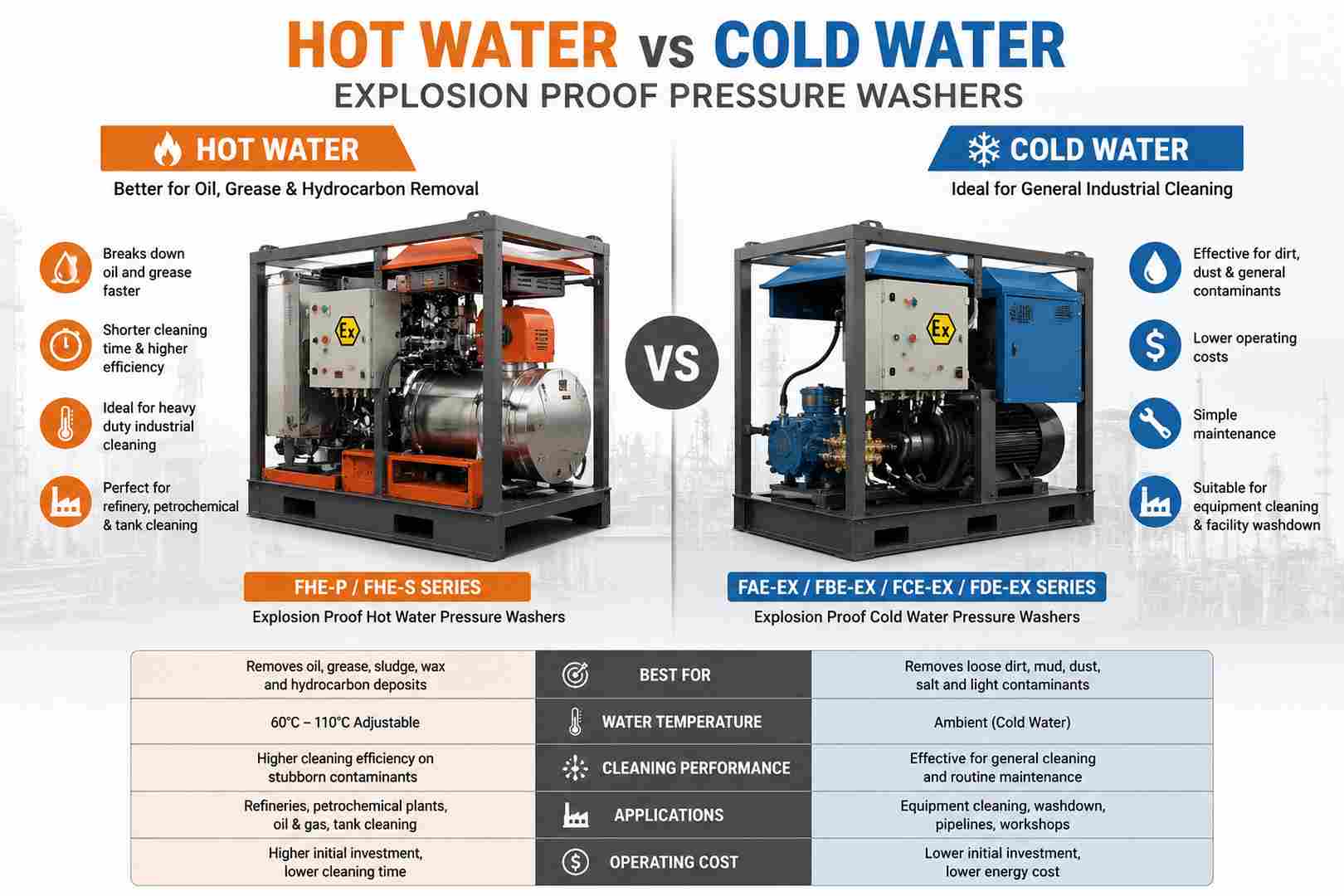
Las hidrolimpiadoras de agua fría a prueba de explosiones son muy eficaces para eliminar suciedad suelta, polvo, lodo, depósitos de sal y contaminantes industriales en general. Se utilizan habitualmente para la limpieza rutinaria de equipos, el lavado de instalaciones, el enjuague de superficies y las tareas de limpieza de mantenimiento.
Para numerosas aplicaciones en refinerías, plantas petroquímicas, terminales de combustible e instalaciones químicas, una hidrolimpiadora de agua fría para zonas peligrosas ofrece un excelente rendimiento de limpieza, a la vez que reduce los costes operativos y simplifica el mantenimiento.
Modelos como el
Serie FDE-EX Son ideales para aplicaciones de limpieza en áreas peligrosas donde el agua a alta presión por sí sola es suficiente para eliminar los contaminantes de forma segura y eficiente.
El agua caliente mejora significativamente la eficacia de la limpieza al tratar con sustancias aceitosas, grasosas o pegajosas. El calor ayuda a descomponer los contaminantes más rápidamente, reduciendo el tiempo de limpieza y minimizando el consumo de agua y detergente.
Las hidrolimpiadoras antiexplosivas de agua caliente se utilizan habitualmente para:
En instalaciones donde abundan los residuos de hidrocarburos y los aceites industriales, el agua caliente suele ofrecer resultados de limpieza superiores en comparación con los sistemas de agua fría.
Una de las mayores ventajas de limpieza con agua caliente Su principal ventaja es su capacidad para disolver y emulsionar aceites, grasas, ceras y depósitos de hidrocarburos. Si bien el agua fría puede eliminar contaminantes superficiales sueltos, suele tener dificultades con los residuos persistentes derivados del petróleo.
En las instalaciones de petróleo y gas, refinerías, plataformas marinas y terminales de almacenamiento de combustible, los sistemas de agua caliente pueden mejorar significativamente la productividad de la limpieza, al tiempo que ayudan a mantener el rendimiento de los equipos y la seguridad en el lugar de trabajo.
Para aplicaciones que requieren limpieza con agua caliente a prueba de explosiones, el Series FHE-P y FHE-S Combinan la capacidad de limpieza de zonas peligrosas con el rendimiento del agua caliente, lo que las hace especialmente adecuadas para el desengrase industrial, la limpieza de equipos de refinería y las operaciones de mantenimiento petroquímico.
Para instalaciones dedicadas a la limpieza general de zonas peligrosas, las hidrolimpiadoras antideflagrantes de las series FAE-EX, FBE-EX, FCE-EX y FDE-EX ofrecen un rendimiento fiable de limpieza a alta presión con configuraciones compatibles con ATEX para entornos industriales exigentes. La elección del sistema adecuado depende, en última instancia, del tipo de contaminantes que se van a eliminar, la frecuencia de limpieza y los requisitos operativos.
Las hidrolimpiadoras antiexplosivas desempeñan un papel fundamental en el mantenimiento de la seguridad, la eficiencia operativa y el cumplimiento normativo en instalaciones de petróleo y gas, refinerías, plantas petroquímicas e instalaciones marinas. Su capacidad para ofrecer un potente rendimiento de limpieza en entornos peligrosos las convierte en una herramienta esencial para el mantenimiento rutinario y los proyectos de parada programada.
Los tanques de almacenamiento utilizados para petróleo crudo, combustibles, productos químicos y derivados del petróleo acumulan lodos, sedimentos, residuos de hidrocarburos y otros contaminantes con el tiempo. La limpieza regular es necesaria para mantener la capacidad de almacenamiento, prevenir la contaminación y garantizar operaciones seguras.
Las hidrolimpiadoras antiexplosivas se utilizan ampliamente para la limpieza de depósitos, ya que pueden operar de forma segura en zonas donde pueden estar presentes vapores inflamables. Los chorros de agua a alta presión eliminan eficazmente los depósitos más resistentes, minimizando el tiempo de inactividad durante las operaciones de mantenimiento.
Los intercambiadores de calor son esenciales para mantener la eficiencia de los procesos en refinerías y plantas petroquímicas. Con el tiempo, la incrustación, la suciedad y los residuos del proceso pueden reducir la eficiencia de la transferencia de calor y aumentar el consumo de energía.
Las hidrolimpiadoras para zonas peligrosas se utilizan con frecuencia para limpiar tubos, superficies y componentes de intercambiadores de calor, lo que ayuda a restaurar su rendimiento y prolongar la vida útil de los equipos. La limpieza con agua a alta presión también reduce la necesidad de utilizar productos químicos agresivos y métodos de limpieza abrasivos.
Las refinerías e instalaciones petroquímicas dependen de una amplia gama de equipos de proceso, incluidos reactores, bombas, válvulas, compresores, separadores y tanques de producción. La acumulación de residuos puede afectar el rendimiento, aumentar los costos de mantenimiento y generar problemas de seguridad.
Los equipos de limpieza a prueba de explosiones permiten a los equipos de mantenimiento eliminar de forma segura contaminantes, residuos químicos, grasa y depósitos de equipos críticos, al tiempo que se cumplen las normativas sobre zonas peligrosas.
Las tuberías pueden acumular incrustaciones, lodos, cera, óxido y depósitos de producto que restringen el flujo y reducen la eficiencia operativa. La limpieza regular de las tuberías ayuda a mantener el caudal y a prevenir interrupciones costosas.
Gracias a sus boquillas especializadas y la tecnología de chorro de agua a alta presión, las hidrolimpiadoras antiexplosivas limpian eficazmente tuberías y líneas de proceso, operando con seguridad incluso en entornos peligrosos. Esto las convierte en herramientas valiosas tanto para el mantenimiento rutinario como para las operaciones de limpieza de emergencia.
Las paradas programadas y los mantenimientos son periodos críticos para la inspección, la limpieza y el mantenimiento de los equipos. Durante estos proyectos, es necesario limpiar grandes volúmenes de equipos de forma rápida y segura para minimizar el tiempo de inactividad.
Las hidrolimpiadoras antiexplosivas se utilizan habitualmente para la limpieza de tanques de almacenamiento, recipientes de proceso, intercambiadores de calor, tuberías y equipos de producción durante las paradas de mantenimiento de las refinerías. Su capacidad para ofrecer un alto rendimiento de limpieza a presión, cumpliendo al mismo tiempo con los requisitos ATEX y de zonas peligrosas, las convierte en una parte importante de las operaciones de mantenimiento.
Las instalaciones marinas operan en algunos de los entornos industriales más exigentes, expuestas constantemente al agua salada, a condiciones corrosivas y a atmósferas explosivas. La limpieza regular es esencial para mantener la fiabilidad de los equipos y prevenir la corrosión.
Los equipos de limpieza marina a prueba de explosiones se utilizan para la limpieza de cubiertas, el mantenimiento de maquinaria, la limpieza de tuberías, la eliminación de corrosión y la preparación de superficies. Los sistemas con componentes de acero inoxidable y construcción resistente a la corrosión son especialmente adecuados para operaciones marinas a largo plazo, lo que ayuda a los operadores a mantener la seguridad y la integridad de los activos en entornos marinos exigentes.
El mantenimiento adecuado es esencial para garantizar la seguridad, la fiabilidad y la vida útil de una hidrolavadora a prueba de explosiones. En entornos peligrosos como refinerías de petróleo, plantas petroquímicas, instalaciones de procesamiento químico y plataformas marinas, inspecciones rutinarias y mantenimiento preventivo Ayudar a reducir los riesgos operativos manteniendo el cumplimiento de las normas de seguridad industrial.
Se deben realizar inspecciones periódicas antes y después de la operación para identificar posibles problemas antes de que afecten el rendimiento o la seguridad.
Los elementos clave de la inspección incluyen:
Los operarios deben atender de inmediato cualquier señal de daño, corrosión, vibración inusual, fuga o ruido anormal. La detección temprana puede prevenir costosos tiempos de inactividad y fallas en los equipos.
Las juntas y las mangueras de alta presión se encuentran entre los componentes de mayor desgaste en cualquier hidrolimpiadora industrial. Las juntas dañadas pueden provocar pérdida de presión, fugas de agua y una menor eficacia de limpieza, mientras que las mangueras desgastadas pueden representar graves riesgos para la seguridad.
Las mejores prácticas de mantenimiento incluyen:
Para las exigentes aplicaciones de equipos de limpieza de refinerías y equipos de limpieza petroquímica, el mantenimiento rutinario de juntas y mangueras es especialmente importante para garantizar un funcionamiento seguro en condiciones de alta presión.
Incluso la hidrolimpiadora para zonas peligrosas más avanzada requiere personal debidamente capacitado para su uso seguro. Los operarios deben comprender tanto los procedimientos de limpieza a alta presión como los requisitos de seguridad para zonas peligrosas.
Los programas de formación deben abarcar:
Los operarios bien capacitados ayudan a reducir los accidentes laborales, mejoran la eficiencia de la limpieza y prolongan la vida útil de los equipos.
Las instalaciones que utilicen hidrolimpiadoras ATEX u otros equipos de limpieza a prueba de explosiones deben mantener registros completos de cumplimiento y documentación de mantenimiento.
Los registros importantes pueden incluir:
La documentación precisa no solo respalda el cumplimiento normativo, sino que también demuestra un compromiso proactivo con la seguridad industrial. Mantener registros detallados simplifica las auditorías, mejora la trazabilidad y contribuye a garantizar que las hidrolimpiadoras antiexplosivas sigan funcionando de forma segura durante toda su vida útil.
Seleccionar la hidrolavadora a prueba de explosiones adecuada va más allá de cumplir con los requisitos de cumplimiento. Los compradores industriales necesitan equipos que ofrezcan un rendimiento fiable, una larga vida útil y la flexibilidad para operar de forma segura en entornos peligrosos exigentes. Con más de dos décadas de experiencia en tecnología de chorro de agua a alta presión, Füssen Ofrece soluciones profesionales en las que confían clientes de una amplia gama de sectores.
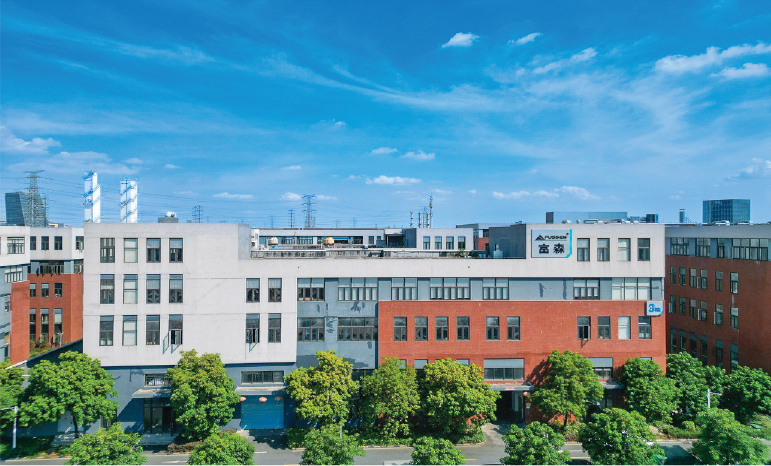
Las hidrolimpiadoras antiexplosivas de Fussen están diseñadas para su uso en entornos peligrosos donde pueden estar presentes gases, vapores o materiales combustibles inflamables. Las configuraciones opcionales compatibles con ATEX y su alta resistencia a las explosiones ayudan a los clientes a cumplir con los requisitos de seguridad de la industria para instalaciones de petróleo y gas, plantas petroquímicas, plantas de procesamiento químico, terminales de almacenamiento de combustible y operaciones en alta mar.
Desde 2001, Fussen se ha especializado en el desarrollo y fabricación de Bombas de émbolo de alta presión y equipos de limpieza industrial. Esta dilatada experiencia permite a la empresa ofrecer equipos de limpieza a prueba de explosiones que combinan seguridad, durabilidad y rendimiento de limpieza.
Mediante el control de la tecnología central de la bomba, Fussen garantiza una presión de salida fiable, un funcionamiento estable y una larga vida útil incluso en aplicaciones industriales exigentes.
A diferencia de muchos proveedores de equipos de limpieza industrial estándar, Fussen ofrece soluciones que van desde sistemas de limpieza industrial generales hasta tecnología de chorro de agua a ultra alta presión.
Con una capacidad de presión de hasta 2800 bar, Fussen puede dar soporte a aplicaciones que incluyen:
Este amplio rango de presión permite a los clientes seleccionar el sistema más adecuado a sus necesidades operativas.
Cada entorno peligroso presenta desafíos únicos. Fussen ofrece soluciones personalizadas de hidrolimpiadoras antiexplosivas en función de las condiciones del lugar, la clasificación de las zonas peligrosas, los objetivos de limpieza, los requisitos de presión y las fuentes de alimentación disponibles.
Tanto si los clientes necesitan hidrolimpiadoras ATEX, sistemas de limpieza de alto caudal, equipos de limpieza para plataformas marinas o configuraciones especializadas para el mantenimiento de refinerías, Fussen puede diseñar soluciones a medida para satisfacer las necesidades específicas de cada proyecto.
Fussen opera bajo el sistema de gestión de calidad ISO 9001 y ofrece productos con certificación CE que cumplen con las normas internacionales de seguridad. Sus equipos se utilizan ampliamente en Europa, Oriente Medio, el Sudeste Asiático y Sudamérica.
Gracias a sus años de experiencia en proyectos internacionales, Fussen ha desarrollado un profundo conocimiento de los requisitos globales de limpieza industrial y de las normas de cumplimiento para áreas peligrosas, lo que ayuda a sus clientes a implementar soluciones fiables en todo el mundo.
Catálogo de hidrolimpiadoras antiexplosivas de Fussen Cubre una amplia gama de aplicaciones de limpieza y requisitos de presión.
En conjunto, estas líneas de productos ofrecen a los compradores industriales soluciones flexibles, fiables y que cumplen con la normativa para la limpieza de zonas peligrosas en los sectores del petróleo y el gas, la petroquímica, la fabricación de productos químicos y otras industrias de alto riesgo.
Una hidrolimpiadora antiexplosiva es una máquina de limpieza de alta presión especializada, diseñada para su uso en entornos peligrosos donde pueden estar presentes gases, vapores o polvo inflamables. Incorpora motores antiexplosivos, sistemas de control con clasificación Ex y componentes eléctricos certificados que ayudan a prevenir la ignición a la vez que ofrecen un rendimiento de limpieza industrial.
Si sus instalaciones operan en atmósferas potencialmente explosivas dentro de la Unión Europea o cumplen con la normativa ATEX, es posible que se requiera equipo certificado. La necesidad de la certificación ATEX depende de la clasificación de su área peligrosa, las sustancias presentes y los requisitos normativos locales. Consulte con su equipo de seguridad o especialista en cumplimiento para determinar el nivel de certificación adecuado.
Las hidrolimpiadoras antiexplosivas se utilizan habitualmente en instalaciones de petróleo y gas, plantas petroquímicas, plantas de fabricación de productos químicos, plataformas marinas, terminales de almacenamiento de combustible, operaciones mineras, instalaciones de pintura y recubrimiento, y otros entornos industriales peligrosos donde se deben controlar los riesgos de explosión.
Sí. Las hidrolimpiadoras de agua caliente a prueba de explosiones se utilizan ampliamente para el desengrase industrial, el mantenimiento de refinerías, la limpieza petroquímica y la eliminación de residuos de aceite, grasa e hidrocarburos. Modelos como las series FHE-P y FHE-S de Fussen combinan el rendimiento de la limpieza con agua caliente con características de seguridad de grado industrial.
La presión ideal depende de la aplicación específica. La limpieza general de equipos puede requerir entre 150 y 300 bares, mientras que la limpieza profunda, la preparación de superficies y la eliminación de depósitos suelen requerir entre 500 y 1000 bares o más. Para aplicaciones especializadas como el hidrolavado y la eliminación de recubrimientos, los sistemas de ultra alta presión pueden superar los 1000 bares.
ATEX es un marco normativo europeo para equipos utilizados en atmósferas explosivas, mientras que IECEx es un sistema de certificación reconocido internacionalmente, desarrollado por la Comisión Electrotécnica Internacional. Ambos se centran en la seguridad en áreas peligrosas, pero IECEx goza de mayor aceptación en un mercado internacional más amplio.
La vida útil depende de las condiciones de funcionamiento, las prácticas de mantenimiento y la calidad del equipo. Una hidrolavadora industrial antiexplosiva con el mantenimiento adecuado puede ofrecer 10 años o más de servicio confiable. Las inspecciones periódicas, el reemplazo oportuno de las piezas de desgaste y la capacitación adecuada del operador pueden prolongar significativamente la vida útil del equipo.

 English
  Spanish
  French
  Russian
  Japanese
  Portuguese
  Arabic
  Korean