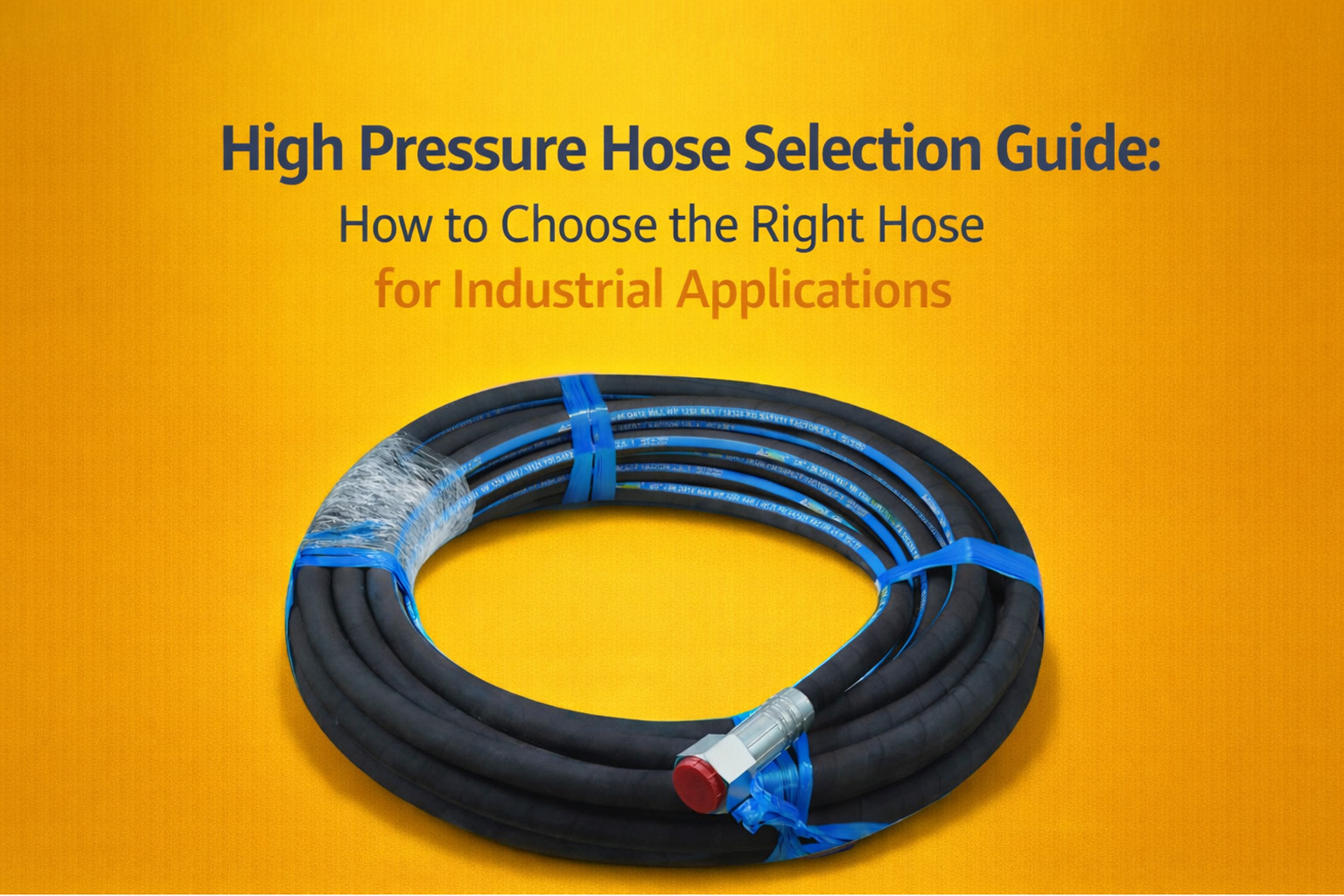
High Pressure Hose Selection Guide: How to Choose the Right Hose for Industrial Applications
Why Correct High Pressure Hose Selection Matters
Selecting the correct high pressure hose is not simply a component choice—it directly affects system safety, operational efficiency, and long-term cost control. In industrial and professional cleaning systems, hoses operate under continuous load, pressure fluctuation, and harsh environments, making correct specification essential.
Safety Risks of Hose Failure Under Pressure
High pressure hoses are exposed to significant internal stress from working pressure, pressure spikes, and pulsation. Using an incorrectly rated hose can result in sudden rupture, hose whipping, or fitting failure, posing serious safety risks to operators and nearby equipment. Proper hose selection—based on working pressure, burst pressure, and safety factor—reduces the likelihood of catastrophic failure and helps meet workplace safety requirements.
Impact on System Efficiency, Downtime, and Maintenance Cost
An undersized or unsuitable hose can restrict flow, cause excessive pressure drop, and force pumps to work harder than intended. This reduces cleaning performance and accelerates wear on pumps, valves, and seals. Conversely, selecting a hose designed for the correct pressure, flow rate, and duty cycle helps maintain stable system output, minimises unplanned downtime, and lowers long-term maintenance costs.
Compliance With Industrial Safety Standards
Many industrial applications require hoses to meet recognised standards such as SAE, EN, or ISO specifications. Correct hose selection supports compliance with these standards, simplifies inspections, and ensures traceability in regulated environments. Using certified, application-appropriate hoses also helps organisations meet internal safety policies and external regulatory requirements.
What Is a High Pressure Hose?
A high pressure hose is a reinforced flexible conduit designed to safely transfer fluids under elevated pressure conditions. In industrial systems, these hoses must withstand continuous internal pressure, pressure fluctuations, mechanical stress, and environmental exposure while maintaining reliable performance.
Definition and Typical Pressure Ranges
High pressure hoses are classified based on their maximum working pressure, with additional consideration given to burst pressure and safety factor. While classifications may vary slightly by industry, common ranges include:
- Medium pressure hoses: Typically up to 3,000 PSI (≈200 bar), used in light industrial and general hydraulic applications
- High pressure hoses: Commonly rated between 3,000–10,000 PSI (≈200–700 bar), suitable for industrial cleaning and hydraulic machinery
- Ultra-high pressure hoses: Rated above 10,000 PSI (≈700 bar), used in water jetting, hydrodemolition, and specialised industrial applications
Selecting the correct pressure class ensures the hose operates within safe limits under both steady-state and peak pressure conditions.
Difference Between Hydraulic Hoses and Pressure Washer Hoses
Although hydraulic hoses and pressure washer hoses may appear similar, they are designed for different operating conditions.
- Hydraulic hoses are engineered to carry oil-based fluids and experience frequent pressure pulses caused by pump cycling and valve operation. They are typically optimised for impulse resistance and compatibility with hydraulic fluids.
- Pressure washer hoses are designed primarily for water or water-based solutions and must handle continuous flow, high static pressure, and abrasion from external surfaces during cleaning operations.
Differences in fluid type, duty cycle, and pressure pulsation mean these hoses are not always interchangeable without risk of reduced performance or premature failure.
Typical Industries Using High Pressure Hoses
High pressure hoses are used across a wide range of industrial sectors, including:
- Industrial cleaning– pressure washing, surface preparation, and water jetting
- Hydraulics and machinery– mobile equipment, presses, and power units
- Petrochemical and process industries– fluid transfer and equipment cleaning
- Marine and offshore operations– corrosion-resistant applications
- Construction and utilities– heavy equipment, infrastructure maintenance
Understanding the operating environment and application requirements is essential to selecting a hose that delivers safe, reliable performance throughout its service life.
Understanding High Pressure Hose Construction
High pressure hose performance is determined by its construction design, which directly affects pressure capacity, flexibility, durability, and compatibility with fluids and environments. Understanding each construction layer helps ensure the hose is correctly matched to the application.
Inner Tube Materials and Fluid Compatibility
The inner tube is the fluid-carrying layer and must be chemically compatible with the media being transferred. Common inner tube materials include:
- Rubber – Widely used for water, hydraulic oil, and general industrial fluids. Rubber hoses offer good flexibility and cost-effectiveness but may have limitations with aggressive chemicals or high temperatures.
- Thermoplastic – Suitable for applications requiring lighter weight, smoother internal surfaces, and improved resistance to certain chemicals. Often used in mobile equipment and pressure washer hoses.
- PTFE (Polytetrafluoroethylene) – Provides excellent chemical resistance and high-temperature capability, making it suitable for aggressive chemicals, solvents, and specialised industrial processes.
Selecting the correct inner tube material is critical to preventing chemical degradation, swelling, or premature failure.
Reinforcement Layers and Pressure Rating
Reinforcement layers provide the hose with its pressure-bearing capability. The type and number of reinforcement layers determine the hose’s working pressure and fatigue resistance.
- Steel wire braid– Common in medium to high pressure hoses. Braided reinforcement offers good flexibility and is suitable for applications with moderate pressure and frequent movement.
- Steel wire spiral– Used in high and ultra-high pressure hoses where maximum strength and impulse resistance are required. Spiral-wound reinforcement provides higher pressure capacity but reduces flexibility compared to braided designs.
Pressure ratings are defined by:
- Working pressure– The maximum pressure the hose can safely handle during normal operation.
- Burst pressure– The pressure at which the hose will fail, typically several times higher than the working pressure.
Hoses should always be selected based on working pressure with an appropriate safety factor, not on burst pressure alone.
Outer Cover and Environmental Protection
The outer cover protects the hose from external damage and environmental exposure. Key protection features include:
- Abrasion resistance– Essential for hoses dragged across rough surfaces or used in industrial cleaning environments.
- UV and ozone resistance– Important for outdoor installations and prolonged exposure to sunlight.
- Chemical and oil resistance– Prevents degradation when hoses come into contact with oils, solvents, or industrial chemicals.
Matching the outer cover material to the operating environment helps extend hose service life and maintain safe operation.
Key Factors in High Pressure Hose Selection
Selecting the correct high pressure hose requires evaluating multiple operating parameters together. A hose that meets pressure requirements but ignores flow, temperature, or routing constraints can still fail prematurely or reduce system performance.
Operating Pressure and Safety Factor
Pressure capability is the first and most critical selection criterion. Hose ratings must account for both normal operating conditions and pressure fluctuations.
- Continuous pressure vs peak pressure
Hoses should be selected based on maximum continuous working pressure, not short-term peak values. Pressure spikes, pulsation, and transient loads are common in hydraulic and pressure washer systems and must be considered. - Industry-standard safety margins
Industrial hoses are typically designed with safety factors between 3:1 and 4:1(burst pressure to working pressure). Always select hoses based on rated working pressure with adequate margin rather than relying on burst ratings.
Hose Size Cover and Flow Rate Requirements
Hose diameter directly affects system efficiency, pressure loss, and heat generation.
- Inner diameter (ID) impact on flow and pressure drop
Undersized hoses increase flow velocity, leading to excessive pressure drop, heat buildup, and accelerated wear. Oversized hoses can reduce responsiveness and increase system volume unnecessarily. - Velocity limits for water and hydraulic fluids
Maintaining recommended flow velocities helps control turbulence and extend hose life. Hydraulic systems and high pressure water applications each have different optimal velocity ranges that should guide hose sizing.
Temperature Range and Thermal Exposure
Operating temperature significantly influences hose material performance and service life.
- Hot water, steam, and ambient extremes
Hoses used with hot water or in high-temperature environments must be rated for continuous thermal exposure, not just intermittent contact. - Effect of temperature on hose lifespan
Elevated temperatures accelerate material aging, reduce pressure capacity, and shorten service life. Hose pressure ratings typically decrease as temperature increases and must be derated accordingly.
Fluid and Media Compatibility
The hose must be chemically compatible with both the working fluid and any external exposure.
- Water, hydraulic oil, fuel, and chemicals
Incompatible fluids can cause swelling, hardening, cracking, or permeation of the inner tube. - Seal and liner considerations
Compatibility extends beyond the hose body to include fittings, seals, and liners, especially in chemical or high-temperature applications.
Minimum Bend Radius and Routing Constraints
Mechanical stress is a common cause of premature hose failure.
- Fixed installation vs mobile equipment
Mobile equipment requires hoses with tighter bend radius capability and higher flex fatigue resistance. Fixed installations may prioritise pressure capacity over flexibility. - Preventing premature fatigue
Exceeding the minimum bend radius, improper routing, or insufficient strain relief can lead to internal reinforcement damage and early failure, even when pressure ratings are met.
High Pressure Hose Sizing Explained
Correct hose sizing is critical for maintaining pressure stability, controlling heat generation, and ensuring long service life. A hose that is incorrectly sized—even if it meets pressure ratings—can reduce system efficiency and accelerate wear.
Inner Diameter (ID), Outer Diameter (OD), and Dash Size
High pressure hoses are primarily sized by inner diameter (ID), which directly determines flow capacity and velocity.
- Inner Diameter (ID)
Governs flow rate, pressure drop, and fluid velocity. ID selection must align with the system’s required flow (L/min or GPM) rather than matching existing fittings by default. - Outer Diameter (OD)
Influenced by reinforcement layers and cover thickness. OD affects routing space, clamp selection, and compatibility with hose reels and protective sleeves. - Dash size system
Hose sizes are commonly expressed in dash sizes, where each dash equals 1/16 inch of ID(e.g., -8 = 8/16″ = 1/2″ ID). Understanding dash sizing helps ensure consistency between hoses, fittings, and system specifications.
Recommended Flow Velocity Ranges
Maintaining proper fluid velocity is essential to avoid excessive pressure loss and internal heat buildup.
- Avoiding excessive pressure loss
High velocities increase friction losses, reducing effective pressure at the nozzle or actuator. - Preventing heat buildup and wear
Excessive velocity accelerates erosion of the inner tube and reinforcement layers, shortening hose life. - Typical velocity guidelines
Water and hydraulic systems have different optimal velocity ranges. Staying within recommended limits improves efficiency, noise control, and long-term reliability.
Using Hose Sizing Charts and Nomographs
Sizing charts and nomographs provide a practical method for selecting the correct hose diameter based on flow and pressure requirements.
- Practical guidance for engineers and technicians
By cross-referencing flow rate, hose length, and allowable pressure drop, engineers can quickly identify suitable hose sizes without over- or under-specifying. - Supporting system design and procurement
Including hose sizing calculations in design documentation helps standardise specifications, reduce installation errors, and support compliance with industrial standards. - Field validation
Final hose selection should be verified under real operating conditions, accounting for temperature, pressure fluctuations, and routing constraints.
Pressure Ratings and Standards You Should Know
Understanding pressure ratings and applicable standards is essential when selecting high pressure hoses for industrial systems. Beyond meeting nominal pressure requirements, hoses must comply with safety margins, fatigue resistance expectations, and internationally recognised standards.
Working Pressure, Burst Pressure, and Impulse Cycles
High pressure hoses are rated using several related but distinct pressure values:
- Working pressure
The maximum continuous pressure the hose is designed to operate under during normal service. All system pressures—including transient spikes—must remain within this limit. - Burst pressure
The pressure at which the hose will fail catastrophically under laboratory conditions. Burst pressure is typically a multiple of working pressure and must never be approached in operation. - Impulse cycle rating
Measures the hose’s ability to withstand repeated pressure fluctuations over time. In systems with frequent starts, stops, or pressure pulsing, impulse performance is often more critical than static pressure rating alone.
Industrial hose selection should prioritise impulse life and fatigue resistance, not just peak pressure numbers.
International Standards (SAE, EN, ISO)
Reputable high pressure hoses are manufactured and tested in accordance with internationally recognised standards, including:
- SAE (Society of Automotive Engineers)
Commonly used for hydraulic hose specifications, defining construction, pressure ratings, and impulse performance. - EN (European Norms)
Widely applied in European markets, with detailed requirements for reinforcement, safety factors, and testing protocols. - ISO (International Organization for Standardization)
Provides globally harmonised standards covering hose design, performance, and test methods across industries.
Specifying hoses to these standards ensures consistency, safety, and compatibility across multinational projects and supply chains.
Certification and Traceability for Industrial Use
For industrial and municipal applications, documentation and traceability are as important as technical performance.
- Certification documentation
Test reports, conformity certificates, and pressure test records provide assurance that hoses meet declared specifications. - Batch and material traceability
Enables identification of production batches, materials, and test data—critical for quality control, audits, and incident investigation. - Compliance with safety and procurement requirements
Certified and traceable hoses reduce risk during inspections, insurance assessments, and regulatory reviews.
Selecting hoses with verified standards compliance and traceability helps protect personnel, equipment, and project accountability over the hose’s entire service life.
Selecting Hose Ends, Fittings, and Couplings
Correct hose end and fitting selection is just as critical as choosing the hose itself. Mismatched or poorly specified fittings are a common cause of leakage, premature hose failure, and safety incidents in high pressure systems.
Fixed vs Swivel Fittings
Hose movement during operation places torsional stress on fittings and reinforcement layers.
- Fixed fittings
Suitable for static installations where hose movement is minimal and alignment can be controlled. They are typically simpler and more cost-effective. - Swivel fittings
Allow rotation between the hose and connected component, reducing twisting and fatigue in mobile or frequently repositioned equipment.
For high pressure washer and mobile industrial systems, swivel fittings are often recommended to extend hose service life.
Crimped vs Reusable Hose Assemblies
The method used to attach fittings directly affects pressure capability and reliability.
- Crimped hose assemblies
Factory- or workshop-crimped fittings provide consistent compression and are preferred for high pressure and continuous-duty applications. They offer higher pressure ratings and improved impulse resistance. - Reusable hose fittings
Designed for field assembly without specialised equipment. While convenient for repairs, they are typically limited to lower pressure ranges and intermittent use.
For industrial high pressure and ultra-high pressure systems, crimped assemblies are generally the safer and more durable option.
Fittings must match all connected components in both mechanical and pressure terms.
- Thread type and sealing method(BSP, NPT, metric, ORFS, etc.)
- Pressure rating of each component—the system is only as strong as its weakest link
- Material compatibilitywith water, oil, chemicals, or detergents
- Flow requirementsto avoid restriction, turbulence, or pressure loss
Specifying hose ends, couplings, and accessories as a matched system—rather than individual parts—helps ensure safe operation, reliable sealing, and long-term performance in high pressure applications.
Application-Specific High Pressure Hose Selection
High pressure hose requirements vary significantly by application. Selecting a hose based only on pressure rating—without considering duty cycle, environment, and fluid type—is a common cause of premature failure. Below are key selection considerations by application category.
Industrial Pressure Washer and Water Jetting Systems
Pressure washer hoses operate under continuous pressure cycling, high flow rates, and frequent handling.
High fatigue and impulse resistance
Smooth inner bore for stable flow and reduced pressure loss
Abrasion-resistant outer cover for ground contact
Medium to ultra-high pressure ratings (depending on application)
Steel wire braid or spiral reinforcement
Compatibility with hot water and detergents when required
For water jetting and road or surface cleaning, hose flexibility and resistance to kinking are as important as pressure capacity.
Hydraulic Machinery and Power Units
Hydraulic hoses are exposed to dynamic pressure pulses, oil-based fluids, and elevated temperatures.
High impulse cycle rating
Oil-resistant inner tube (typically synthetic rubber)
Compliance with SAE, EN, or ISO hydraulic standards
Defined safety factors (often 4:1 burst-to-working pressure)
Controlled bend radius for compact machinery layouts
Hydraulic hose selection must account for peak pressure spikes rather than nominal system pressure alone.
Petrochemical and Refinery Environments
These environments combine high pressure with chemical exposure and strict safety regulations.
Chemical-resistant inner liners (often PTFE)
Fire-resistant and anti-static outer covers
Full material traceability and certification
High temperature tolerance
Compliance with refinery and hazardous-area standards
In petrochemical applications, hose failure can have severe safety and environmental consequences, making conservative selection essential.
Marine, Offshore, and Corrosive Environments
Saltwater exposure and humidity accelerate corrosion and material degradation.
Corrosion-resistant reinforcement and fittings
UV- and ozone-resistant outer covers
Sealed fittings to prevent moisture ingress
Stainless steel or coated fittings
Enhanced outer jacket protection
Marine hoses must maintain flexibility and pressure integrity despite constant environmental stress.
Construction and Heavy Equipment
Construction sites subject hoses to mechanical abuse, movement, and dirt contamination.
High abrasion and cut resistance
Flexibility for mobile equipment
Secure fittings resistant to vibration
Reinforced outer covers
Swivel fittings to reduce torsional stress
For heavy equipment, hose durability often has a greater impact on uptime than maximum pressure rating alone.
Common High Pressure Hose Selection Mistakes
Even experienced operators and engineers encounter premature hose failures due to overlooked selection details. Understanding these common mistakes helps reduce safety risks, downtime, and unexpected maintenance costs.
Underrating Pressure or Temperature
Selecting a hose based only on nominal system pressure or ambient temperature is a frequent error.
- Peak pressure spikes, startup surges, and pressure pulsation can exceed nominal ratings
- Elevated temperatures—especially in hot water or hydraulic oil systems—reduce hose material strength and service life
Hoses should always be specified with adequate safety margins above maximum operating pressure and temperature.
Oversizing or Undersizing Hose Diameter
Incorrect hose diameter selection directly affects system performance.
- Undersized hoses increase flow velocity, causing pressure loss, heat buildup, and accelerated wear
- Oversized hoses reduce system responsiveness and can create routing and connection issues
Proper sizing balances flow rate, velocity limits, and pressure stability.
Ignoring Pulse Pressure and Vibration
Many high pressure systems operate under cyclic loading rather than steady pressure.
- Hydraulic systems generate frequent pressure pulses
- Mobile equipment introduces vibration, flexing, and torsional stress
Hoses must be rated for impulse cycles and installed with sufficient flexibility to absorb movement without fatigue.
Mixing Incompatible Hose and Fittings
Using mismatched hoses, fittings, or coupling standards can compromise the entire assembly.
- Incompatible crimp specifications reduce holding strength
- Incorrect fitting materials accelerate corrosion or seal failure
- Mixing standards may invalidate certifications and warranties
Hose assemblies should always be designed, crimped, and tested as a matched system.
How to Extend High Pressure Hose Service Life
Correct hose selection is only the first step. Installation quality, operating practices, and maintenance discipline all play a critical role in determining actual service life—especially in high-pressure and pulse-heavy systems.
Proper Installation and Routing
Poor routing is one of the leading causes of premature hose failure.
- Avoid sharp bends below the minimum bend radius
- Prevent twisting during installation, especially near fittings
- Allow sufficient slack for movement, vibration, and thermal expansion
- Protect hoses from abrasion, crushing, and contact with hot surfaces
Proper routing reduces internal stress, fatigue, and reinforcement damage.
Inspection and Maintenance Best Practices
Routine inspection helps identify issues before failure occurs.
- Check for external abrasion, cuts, blistering, or exposed reinforcement
- Inspect fittings for leakage, corrosion, or looseness
- Monitor hose stiffness or surface cracking, which may indicate material aging
- Track operating hours and pressure cycles for critical hoses
Scheduled inspections are especially important in continuous-duty or safety-critical systems.
Storage and Handling Guidelines
Improper storage can shorten hose life before it is even installed.
- Store hoses away from direct sunlight, ozone sources, and chemicals
- Keep hoses clean, dry, and loosely coiled
- Avoid sharp bends or stacking heavy objects on stored hoses
- Use protective caps to prevent contamination of hose ends
Controlled storage conditions preserve material integrity and flexibility.
When to Replace a High Pressure Hose
Hoses should be replaced proactively—not only after failure.
Replace a hose if you observe:
- Visible reinforcement exposure
- Persistent leakage at the hose body or fittings
- Significant stiffness, cracking, or deformation
- Exceeded service life or impulse cycle limits
Preventive replacement reduces unplanned downtime and safety risk.
High Pressure Hose Selection Checklist
Before specifying or installing a high pressure hose, confirm the following:
Pressure Rating
- Maximum working pressure meets or exceeds system requirements
- Peak and pressure spikes are accounted for
- Appropriate safety factor applied (typically 2:1 to 4:1 depending on standard)
- Impulse and pressure cycle rating suitable for duty cycle
Flow Rate & Hose Diameter
- Required flow rate (L/min or GPM) confirmed
- Inner diameter (ID) selected to avoid excessive velocity
- Pressure drop within acceptable limits
- Hose length minimised where possible
Temperature Range
- Continuous fluid temperature within hose rating
- Peak temperature and thermal cycling considered
- Ambient temperature exposure accounted for
Fluid & Media Compatibility
- Inner tube material compatible with fluid (water, oil, fuel, chemicals)
- Resistance to detergents, additives, or cleaning agents verified
- Seal and liner compatibility confirmed
Hose Construction
- Reinforcement type selected (wire braid or spiral wire)
- Working pressure vs burst pressure clearly identified
- Outer cover suited for abrasion, UV, ozone, or chemical exposure
Bend Radius & Routing
- Minimum bend radius respected under operating conditions
- Hose routing avoids twisting, kinking, or sharp edges
- Allowance for movement, vibration, and expansion
Fittings & Connections
- Correct fitting type (fixed or swivel)
- Crimp compatibility between hose and fittings
- Thread type, sealing method, and material matched to system
- Compatibility with pumps, valves, guns, and manifolds
Operating Environment
- Indoor or outdoor exposure
- Abrasive, corrosive, or high-vibration conditions
- Mobile vs fixed installation
Compliance & Safety
- Meets relevant standards (SAE, EN, ISO)
- Certification and traceability available
- Suitable for industry-specific safety regulations
Maintenance & Service Life
- Inspection and replacement intervals defined
- Availability of replacement hoses and fittings
- Total lifecycle cost considered, not just purchase price
High Pressure Hose Solutions for Industrial Systems
In industrial cleaning and fluid handling systems, high pressure hoses should never be selected in isolation. Hose performance is directly linked to pump characteristics, operating pressure and flow, duty cycle, and the accessories used throughout the system. Mismatched hoses can lead to premature failure, unstable pressure, excessive wear, and increased downtime—regardless of hose quality.
For pressure washer and high-pressure fluid systems, proper hose selection must account for:
- Continuous operating pressure and pressure fluctuations generated by the pump
- Flow rate requirements and velocity limits to minimise pressure loss and heat buildup
- Temperature exposure from hot water, ambient conditions, or nearby equipment
- Mechanical stress caused by routing, vibration, and mobile operation
From an engineering standpoint, the most reliable systems are those designed as a complete package—pump, hose, fittings, spray equipment, and safety devices working together within defined limits. Application-specific hose selection helps protect core components, stabilise output, and extend overall system service life.
Fussen supports industrial users by providing system-matched high pressure solutions, where hoses, pumps, and accessories are specified as part of an integrated design rather than individual components. This approach ensures compatibility, improves operational reliability, and simplifies long-term maintenance across industrial cleaning and high-pressure applications.
Conclusion: Selecting the Right High Pressure Hose Is a System-Level Decision
Choosing the correct high pressure hose is not simply a matter of matching a pressure rating. Hose performance directly affects system safety, cleaning efficiency, operating stability, and long-term maintenance costs. Incorrect sizing, inadequate pressure margins, or poor material compatibility can lead to premature hose failure, unplanned downtime, and safety risks—especially in continuous-duty industrial environments.
A proper high pressure hose selection process considers pressure and flow together, evaluates temperature and media exposure, and accounts for routing, vibration, and duty cycle. When hoses are selected as part of a complete system—matched to pumps, fittings, and accessories—the result is more stable operation, longer service life, and lower total cost of ownership.
For industrial cleaning, pressure washing, and high-pressure fluid applications, understanding these fundamentals helps avoid common selection mistakes and ensures the hose performs reliably throughout its intended service life.
Get Expert Support for High Pressure Hose Selection
Every industrial application places different demands on pressure, flow, temperature, and durability. Consulting experienced system engineers early in the selection process helps ensure the hose, pump, and accessories work together safely and efficiently.
If you are specifying hoses for industrial pressure washers, high-pressure cleaning systems, or ultra-high-pressure applications, seek professional guidance to confirm sizing, ratings, and compatibility before installation.
Contact a high-pressure system specialist to review your application and ensure the correct hose selection from day one.


 English
  Spanish
  French
  Russian
  Japanese
  Portuguese
  Arabic
  Korean